Salary Cap vs. Draft College Fantasy Football: Which Format Is Right for You?
Sam Horbal
Sam Horbal is the founder and developer of CollegeFFB, a free college fantasy football game and home of the CFB Hub. A lifelong college football fan, Sam built CollegeFFB to make following the sport more interactive, from fantasy play to stats and rankings.
There is more than one way to play college fantasy football, and the format you pick changes the game more than the scoring settings do.
Most American fantasy players learned the sport through NFL drafts. You get a group together, you pick players one at a time, and once a player is gone he is gone. That is traditional draft fantasy, and college fantasy football has been played that way for years.
The other option is salary cap. Everyone gets the same budget, everyone shops from the same player pool, and multiple teams can roster the same player.
Draft fantasy: managers select players in a league draft, and each college football player can typically be rostered by only one team in that league.
Salary-cap fantasy: every participant receives the same starting budget and builds a roster from a shared player pool, so multiple teams can own the same player.
Neither format is right for everyone. Traditional drafts offer the familiar fantasy experience most NFL players already know. Salary cap removes some of the logistical limitations of a draft and introduces a different kind of strategy, one that fits several specific characteristics of college football unusually well.
Salary cap is sometimes framed as the easier option because it does not require a draft. Convenience is only one of the differences. The format also changes where scarcity comes from, how a manager gains an edge and how large a single competition can be. Here is how the two compare.
Salary Cap vs. Draft College Fantasy Football at a Glance
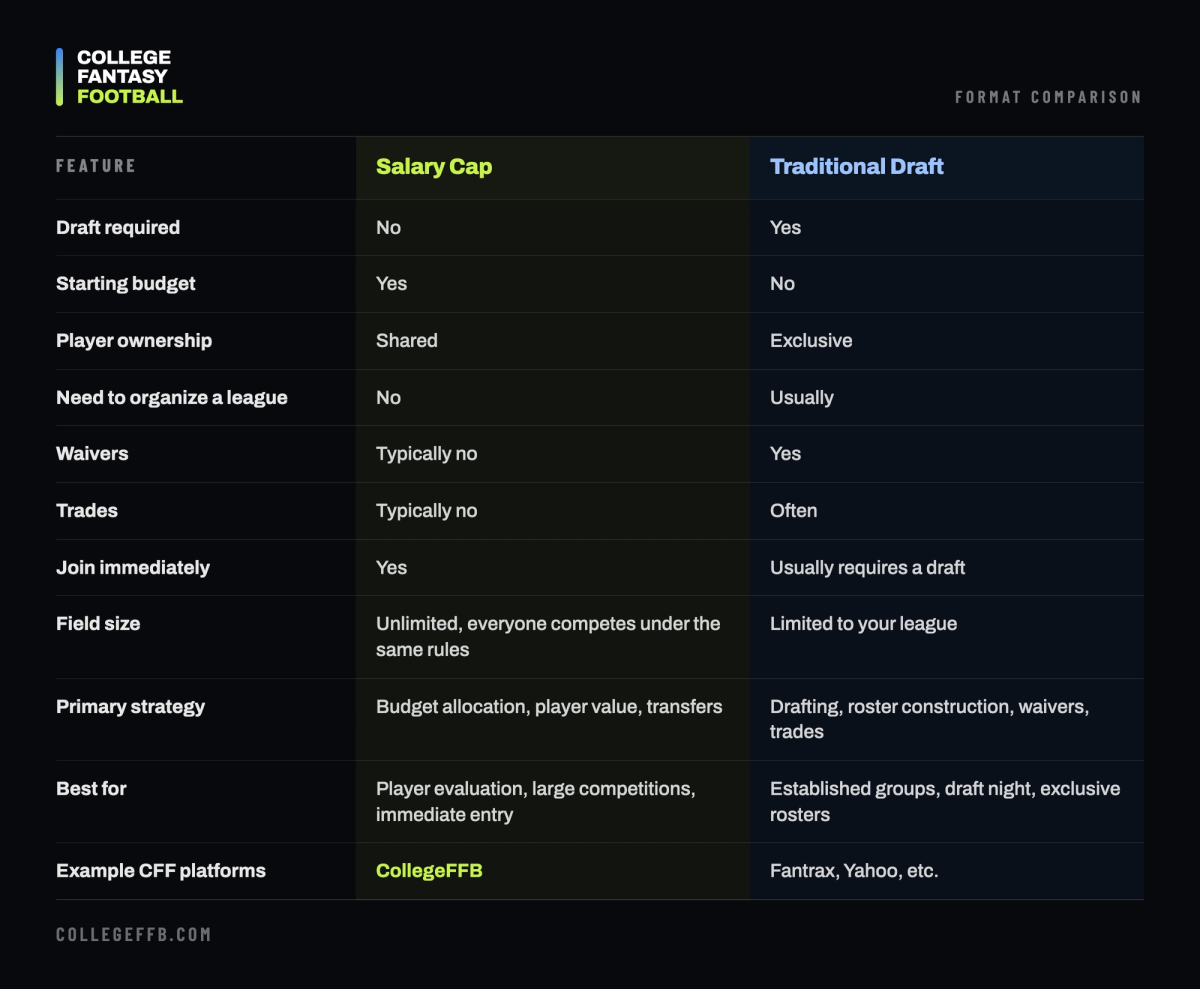
Rules vary by platform. Some draft leagues cap roster moves, some salary-cap games allow limited trading, and scoring is its own conversation. Treat the table as the general shape of each format rather than a rulebook.
How Does Traditional Draft College Fantasy Football Work?
Traditional draft college fantasy football works the same way NFL fantasy does. A group of managers holds a draft, selects players one at a time, and each player belongs to exactly one team for the season unless he is dropped or traded.
The season then runs on roster management. You set a lineup every week, you pick up injury replacements and breakouts off waivers or free agency, and you negotiate trades with the other managers in your league. Depth matters, because you are the only person who can use the players you own, and you are also the only person who can cover for them when three of your starters are idle in the same week.
Winning a draft league usually comes down to three things: how well you prepared for the draft, how quickly you spotted the in-season breakout, and how well you managed a roster over four months.
Advantages of Draft College Fantasy Football
- Immediately familiar to anyone who plays NFL fantasy
- Draft night is an event, and for a lot of people it is the best day of the fantasy season
- Exclusive ownership creates scarcity, which makes every pick feel consequential
- Trades and waivers add a layer of negotiation that lasts all season
- Works well for an established group that wants a shared season-long story
Potential Drawbacks
- You need to find enough committed managers, which is the part that kills most leagues before they start
- Everyone has to be free at the same time for a draft, or willing to autodraft
- College football has thousands of fantasy-relevant players across 130-plus teams, which makes draft prep a much bigger job than it is in the NFL
- Joining after the season starts is awkward at best
- One manager who stops setting a lineup in October distorts both the standings and the player pool for everyone else
How Does Salary Cap College Fantasy Football Work?
Salary-cap college fantasy football gives every participant the same starting budget and the same player pool. Each player carries a price, and you build a roster by deciding how to spend that budget. There is no draft.
The prices are the whole game. A star quarterback might eat 15 percent of your budget on his own. A second-year receiver in a new offense might cost a third of that. So the question stops being "who is the best player available" and becomes "is this player worth what he costs me everywhere else on my roster."
Because ownership is shared, you and everyone else can roster the same player. If a running back goes for 250 yards, the managers who own him gain nothing on each other. The separation comes from the players you owned that most of the field did not, which is why ownership percentage becomes a live strategic input rather than trivia.
The usual objection to shared ownership is that everyone ends up with the same team. That is a real risk in a small player pool. If a salary-cap game only had 32 teams to draw from, the field would converge on a template within a few weeks, because there are only so many defensible ways to spend the budget.
College football does not have that problem. There are more teams, more players per team, and a constant supply of freshmen, transfers and walk-ons who become fantasy-relevant without warning. Schedules vary so much that two players at the same price can be worth completely different things depending on who they play in a given month. The result is that the number of genuinely viable roster constructions is enormous, and two managers who both spent well rarely end up with the same names.
In other words, shared ownership is potentially a much bigger problem in NFL fantasy than in college fantasy. College football's enormous player pool is one of the reasons the format works here.
In-season moves are usually handled through transfers rather than waivers and trades. You get a set number of roster changes per week, you swap players in and out subject to your budget, and prices tend to move over the season based on performance and demand.
Advantages of Salary Cap College Fantasy Football
- No scheduled draft, so nothing has to be coordinated
- You can create a team and start playing in a few minutes
- Every player in the country is available to you, which matters when the player pool is this large
- Thousands of managers can compete in one unified competition under identical rules without diluting the player pool
- Your roster decisions are directly comparable against the entire field, not just against eleven other people
- Ownership percentage adds a strategic dimension that draft leagues do not have, since you are weighing what the field is doing as well as what a player will score
- Private leagues sit inside the larger competition, so playing with friends and playing against everyone are not mutually exclusive
- Finding a breakout before the field does still creates a real edge, because being early on a cheap player is worth more than being one of forty thousand people who bought him in November
- A bad opening roster is recoverable, because you can transfer your way out of it
Potential Drawbacks
- There is no draft night, and no replacement for it
- You never get the specific satisfaction of being the only person in your league who owns the breakout
- Trading is generally not part of the format, which removes an entire social layer
- The format is less familiar to American fantasy players and takes a week or two to click
- Budget management is its own learning curve, and new managers routinely overspend at the top and field an unusable bench
Why the Format Question Matters More in College Fantasy Football
College football is not just the NFL with more teams and different logos. It is structurally different in ways that put real pressure on how a fantasy game is designed.
The player pool is enormous. There are 130-plus FBS teams and thousands of fantasy-relevant players. NFL fantasy has a knowable universe. College does not.
Weekly matchup quality swings wildly. A schedule can put a top-ten offense against an overmatched opponent one week and a top-five defense the next. Matchup exploitation matters more here than it does in the NFL.
Rosters are volatile. Depth charts change fast, freshmen emerge without warning, and the transfer portal reshuffles rosters between seasons in a way the NFL has no equivalent to.
Bye weeks are messier. More teams and less standardized scheduling means more weeks where your lineup has holes.
The player base is smaller. Finding ten people who want to play NFL fantasy is easy. Finding ten friends who can name three tight ends in the Big 12 is a different problem.
Traditional drafts can absolutely work in this environment, and plenty of good leagues do. But the draft format was inherited from NFL fantasy rather than designed around any of the above. Salary cap addresses several of these characteristics as a byproduct of how it works: every player stays accessible no matter how large the pool gets, roster mistakes are recoverable through transfers, an unlimited number of people can compete together without anyone getting locked out of players, and managers can react week to week to a sport that changes shape constantly. The size of the pool also solves the usual complaint about shared ownership, since there are far too many viable options for the field to converge on one roster.
That is not an argument that salary cap is better. It is an argument that the format question is worth actually thinking about in college fantasy football, in a way it mostly is not in the NFL.
The Biggest Difference: Exclusive Ownership vs. Shared Ownership
Everything else follows from this one distinction.
In a draft league, if the manager picking ahead of you takes the consensus QB1, you are done. You are not getting him. You move to the next quarterback on your board and build around a different player.
In salary cap, you can absolutely have the QB1. What you cannot do is have him for free. Paying up at quarterback means you are shopping in the discount aisle at running back and receiver, and the manager who passed on him has real money to spend where you no longer do.
So the core decision changes shape:
Draft asks: which available player should I take?
Salary cap asks: is this player worth this percentage of my budget?
It is worth being precise about what changes here. Salary cap does not eliminate scarcity. It changes what is scarce. In a draft, the players themselves are scarce, and that scarcity is created by the other managers in your league. In salary cap, your budget is scarce, and that constraint applies identically to everyone.
That distinction has a consequence. In a draft, part of your outcome is determined by draft position and by what the person picking two spots ahead of you decided to do. In salary cap, every manager starts with the same information, the same players and the same resources. The separation comes from how efficiently you allocate them.
Neither is objectively harder. Draft rewards board management, reading a room and knowing when a positional run is about to start. Salary cap puts more of the emphasis directly on player evaluation and pricing judgment, because nobody else can remove a player from your available pool.
There is also a difference in what a hit feels like. Think about how Ashton Jeanty went from a name only Group of Five obsessives knew to a Heisman finalist. In a draft league, the manager who took him late owned that outright and nobody in the league could touch it. In salary cap, everyone could have bought him, and the edge belonged to whoever bought him early and cheap while 95 percent of the field spent that money on a name brand. Both are satisfying. They are just satisfying for different reasons.
Which Format Requires More Strategy?
Both formats require significant strategy. The strategy is pointed at different problems.
Draft strategy runs on:
- ADP and where value falls relative to it
- Positional scarcity
- Draft order and the turn
- Roster construction and depth
- Waiver priority or FAAB budgeting
- Trade negotiation
- Identifying breakouts before anyone else in your league does
Salary-cap strategy runs on:
- Budget allocation across positions
- Player value relative to price
- Stars-and-scrubs versus a balanced roster
- Finding underpriced players before the price rises
- Ownership percentage and when to differentiate from the field
- Spending transfers efficiently instead of chasing last week's scores
- Price movement over the season
- Captain selection, where the platform uses it
Salary cap is not simplified fantasy. It moves the strategic emphasis from access to allocation. In a draft you are competing with your leaguemates for the right to use players. In salary cap everyone has that right, so you are competing purely on judgment about what those players are worth.
Which Format Is Better for Beginners?
Draft is more familiar. Salary cap is arguably more accessible. Those are not the same thing.
If you already play NFL fantasy, a draft league will feel like home. The mechanics transfer directly, and you will not need anyone to explain waivers to you.
But familiarity is doing a lot of work in that sentence, and it only helps people who already play fantasy football. A true college fantasy beginner starting with a draft league has to find or build a league, learn a player pool of several thousand names, prepare for a draft, show up at a specific time, and then live with the roster that produced.
The salary-cap version is: sign up, here is your budget, pick the players you want. You can learn the player pool over the season instead of cramming for one night in August, and if your first roster is bad you transfer out of it.
So the honest answer is that draft is easier for people who already play NFL fantasy, and salary cap has a lower barrier to entry for everyone else.
Which Format Is Better for Playing With Friends?
Both work with friends. They organize the competition differently.
Traditional draft leagues are excellent for a fixed, committed group. Exclusive rosters, trade offers in the group chat, waiver grudges and a draft night people schedule around. That is a specific and good experience, and salary cap does not reproduce it.
What salary cap does is remove the weakest link problem. Your league can have four people or forty. Nobody has to clear a Tuesday night in August. And when someone loses interest in October, they are not sitting on a roster of players nobody else can use, because in a shared pool one abandoned team does not change the market for anyone.
There is also a structural point that draft leagues cannot match: you do not have to choose between playing with your friends and playing against everyone. A private league in a salary-cap game is a layer on top of the overall competition. You are in your friends' standings and the global standings at the same time, with the same team.
The distinction:
Draft: your friends collectively create the player market.
Salary cap: your friends compete inside the same market as everyone else, and against everyone else at the same time.
Is Salary Cap Fantasy Similar to Fantasy Premier League?
Yes, conceptually. Fantasy Premier League is the most widely played version of this format in the world, and it popularized the season-long salary-cap model.
FPL runs on a fixed starting budget, shared player ownership, individual player prices, a limited number of weekly transfers and a captain who scores double. Millions of people play the same competition against each other while also running private mini-leagues with friends. That structure is also what allows millions of people to participate in a single competition. A traditional draft format inherently limits each player pool to a much smaller league.
Salary-cap college fantasy football applies the same concepts to college football. If you have played FPL, you already understand the format and are mostly learning a new sport's player pool rather than a new game.
Who Should Choose Each Format?
Choose traditional draft college fantasy football if:
- You already have a group of committed players
- Draft night is a meaningful part of fantasy football for you
- You want exclusive ownership of your players
- You want trades and waivers
- You prefer traditional NFL-style fantasy mechanics
Choose salary-cap college fantasy football if:
- You want more of the competition to revolve around player evaluation and pricing rather than draft position
- You enjoy finding underpriced players and building around value
- You want to compete against a large field and see how your decisions rank against everyone
- You want to play with friends and in a global competition at the same time
- You do not have enough people for a full league, or do not want to coordinate a draft
- You want to start playing immediately
- You already play FPL or a similar game
Where Can You Play Each Format?
Traditional draft college fantasy football is available on general fantasy platforms. Fantrax has the most established college football support, and Yahoo and similar sites have hosted college leagues with varying levels of built-in player data. These are the places to go if you want a draft.
CollegeFFB takes the salary-cap approach. Managers receive a $100 million budget to build a roster from a shared player pool, then manage that roster through the season with weekly transfers.
The format specifics:
- No draft required
- $100M starting budget
- Shared player pool, so any manager can roster any player
- Weekly transfers instead of waivers
- Dynamic player prices that move with performance and demand
- Captain selection each week
- Private leagues that run inside the larger competition
- One global competition where everyone plays under identical rules
If you want more on the category generally, see How to Play College Fantasy Football in 2026, Where to Play College Fantasy Football and Why College Fantasy Football Needs Its Own Format.
Is Salary Cap College Fantasy Football Just a Niche Format?
Salary cap is less common than traditional draft fantasy in American football, but it would be misleading to equate less familiar with less proven. Fantasy Premier League runs on the same core mechanics, including shared player ownership, a fixed budget, transfers and captains, at a scale no draft league can reach.
In college fantasy football specifically, draft remains the more familiar format. Salary cap is better understood as an alternative approach than as a simplified version of draft fantasy. It trades exclusive ownership, waivers and trades for budget allocation, price movement, ownership strategy and the ability for everyone to compete in one unified game. Those are different mechanics with their own depth, not fewer mechanics.
Salary Cap vs. Draft CFF: Final Verdict
There is no universal best college fantasy football format, but there is a real choice to make.
If draft night, exclusive ownership, trades and waivers are the parts of fantasy you love most, traditional college fantasy football is probably the better fit. Those things are the format's whole appeal, and salary cap does not try to replicate them.
If you care more about player evaluation, budget strategy, finding value before the field and competing against more than eleven other people, salary cap offers a different game worth playing on its own terms. It happens to remove the need to coordinate a draft, but convenience is not the interesting part. The format creates a fundamentally different strategic problem, and one that fits the size and unpredictability of college football particularly well.
Draft is the traditional format because NFL fantasy made it familiar. That is a good reason, not a definitive one.
FAQ
Is college fantasy football usually draft or salary cap?
Draft leagues have historically been the more familiar format for American fantasy players, since they mirror NFL fantasy. Salary-cap formats offer an alternative that does not require a draft and lets an unlimited number of people compete in the same competition.
Can you play college fantasy football without a draft?
Yes. Salary-cap college fantasy football lets you build a team from a shared player pool without holding a draft.
What is salary-cap college fantasy football?
Salary-cap college fantasy football is a season-long format where every participant receives the same starting budget and builds a roster from a shared player pool. Players carry different prices, so managers decide how much of the budget to spend on stars versus cheaper options.
Can two teams own the same player in salary-cap fantasy?
Yes. Unlike draft fantasy, salary-cap formats use shared ownership, so any number of managers can roster the same player. The strategic edge comes from ownership percentage rather than exclusivity.
What college fantasy football platforms use salary cap?
CollegeFFB uses a salary-cap format rather than a traditional draft.
Is salary-cap fantasy like FPL?
Yes. Both use a fixed starting budget, shared player ownership, player prices, transfers and captain selections. The exact rules differ by platform.
About the Author
Sam Horbal
Sam Horbal is the founder and developer of CollegeFFB, a free college fantasy football game and home of the CFB Hub. A lifelong college football fan, Sam built CollegeFFB to make following the sport more interactive, from fantasy play to stats and rankings.