How CollegeFFB Rankings and Projections Work
Projecting college football is messy.
There are 137 FBS teams, thousands of fantasy-relevant players, wildly different offensive systems and a lot more week-to-week uncertainty than you typically see in the NFL. A player can go from an afterthought to a major part of an offense in a matter of weeks, while injuries, depth chart changes and matchup differences can completely change a player's outlook from one Saturday to the next.
That's why we didn't want the CollegeFFB rankings to simply be a list of players ordered by what they've scored so far.
Our goal is to answer a more useful question:
Based on everything we know right now, what should we expect this player to do this week?
It starts with what players are actually doing
Past fantasy points matter, but the box score doesn't always tell the whole story.
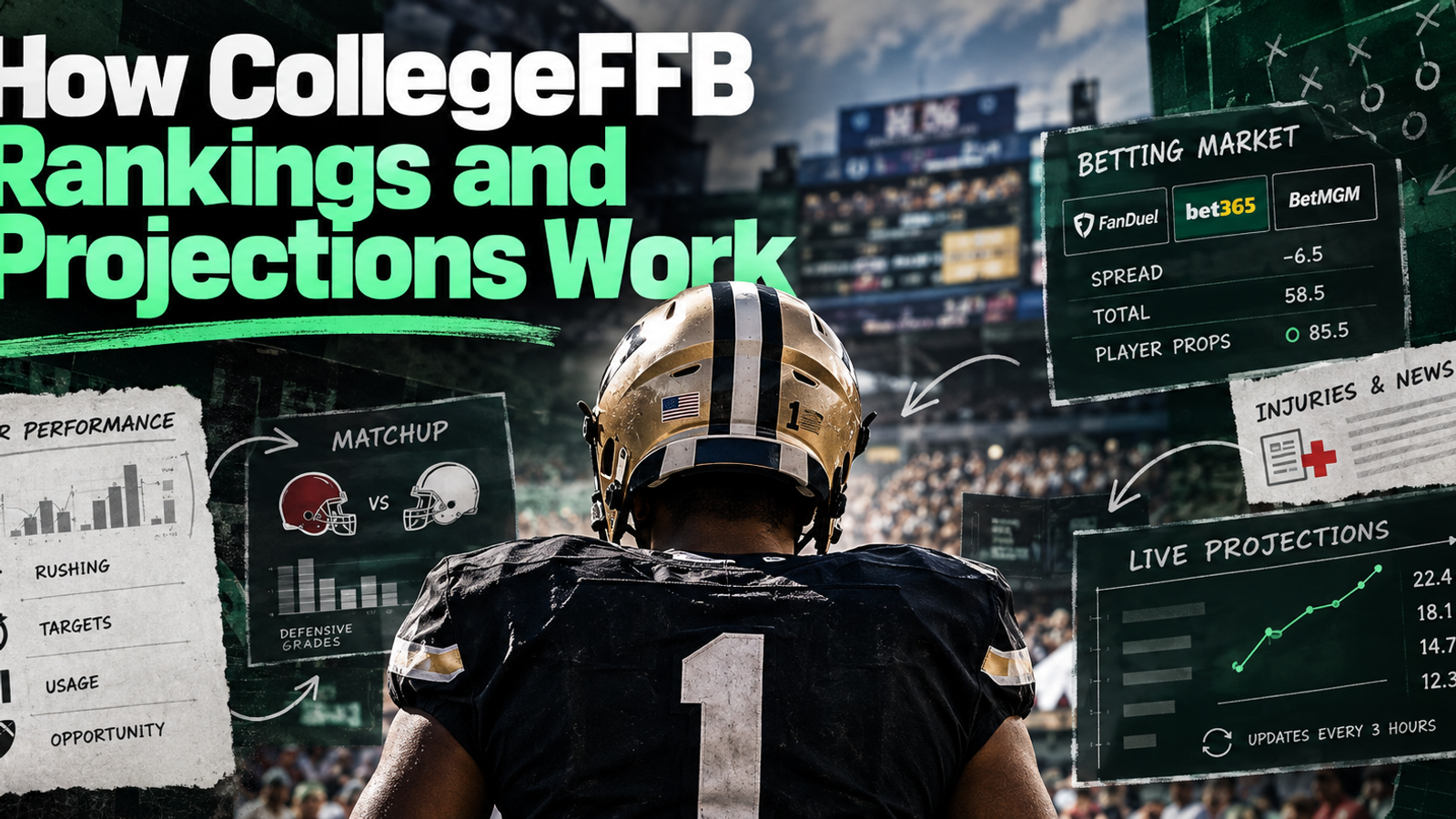
Our projection model looks at a player's underlying production and usage, including things like rushing volume, targets, receiving involvement and other indicators of how that player is being used within his offense.
That distinction matters.
Two receivers might both finish a game with 80 yards, but getting there on three catches and four targets tells a very different story than getting there on eight catches and 12 targets. We're interested not only in what happened, but in the opportunity behind it and what that can tell us about the next game.
From there, we adjust for the upcoming matchup.
A huge performance against an elite defense should tell us something different than the same stat line against one of the weakest defenses in the country. Opponent strength, expected game environment and each player's recent role all help establish the statistical baseline for the upcoming week.
Then we add the betting market
Betting data is another important part of the model.
And to be clear, using betting lines in sports projections isn't something we invented. There's a good reason they're used throughout sports analytics: sportsbooks and betting markets provide another constantly changing estimate of how a game is expected to play out.
For CollegeFFB, that gives us another source of information to compare against what our statistical model sees.
Game totals and spreads help establish the expected scoring environment and likely game script. When player props are available, they can provide an even more direct market expectation for an individual player's production.
Rather than treating that information as gospel, we use it as another signal.
If our statistical model loves a quarterback because of his recent production and matchup, but the betting market has materially different expectations for the game, that's useful information. The opposite is true too.
The advantage comes from combining the two.
Why this is especially useful in college football
The difficult part is that college betting markets aren't nearly as complete as NFL markets.
A nationally televised matchup might have a deep selection of player props. A lower-profile game might have very few or none at all.
If we built rankings entirely from player props, we'd end up with great information on some players and virtually nothing on others. That's not particularly helpful when you're trying to rank players across all 137 FBS programs.
Our underlying model allows us to project players even when the market doesn't give us much to work with. When strong market data is available, we can incorporate that information too.
That combination is particularly important for CollegeFFB because we're trying to create one projection system across the entire FBS player pool, not just the handful of games and players receiving the most attention that week.
The rankings can change throughout the week
This might be the most important part of the entire system.
A projection on Sunday shouldn't necessarily be the same projection you see on Thursday.
Betting lines move. Injury designations change. Player props get posted. A questionable starter gets cleared. Another gets ruled out. The expected scoring environment for a game changes.
So our projections aren't published once and forgotten about.
From the time rankings initially go live through the weekly CollegeFFB lock, we rerun the projection model roughly every three hours using the latest information available to us.
As the projections change, the rankings change with them.
That's also what the arrows on the rankings page represent. A green or red arrow compares a player's current ranking with our initial projection for that week, giving you a quick way to see whose outlook has improved or declined as new information has come in.
It effectively turns the rankings into a living board throughout the week rather than a static article published several days before kickoff.
How to actually use the projections
The projected fantasy points number is not supposed to tell you exactly how many points someone will score.
If we project a player for 18.4 points, we're obviously not claiming he's going to score exactly 18.4.
Think of it as our current estimate of his expected fantasy production based on the information available at that moment.
That makes the projections most useful comparatively.
If you're deciding between two quarterbacks, considering a transfer or looking for a cheaper player who could outperform his price, the projections give you a consistent baseline for comparing those options.
We've also built Projected Points per Dollar directly into the rankings for that reason.
The highest-projected player isn't always the best player to add in a salary-cap format. A $14.0M receiver projected for 20 points might be a great option, but an $8.0M receiver projected for 17 could give you much more flexibility elsewhere in your squad.
Projected Points per Dollar helps surface those players who might otherwise get buried further down the rankings.
Season Points per Dollar gives you another lens, showing who has delivered the most production for their current CollegeFFB price over the course of the season.
One looks forward. The other looks backward. Neither should make the decision for you, but together they can make some of the less obvious values much easier to find.
Rankings are a tool, not an answer key
No projection system can eliminate the chaos that makes college football college football.
A freshman can suddenly earn more touches. A coach can change the game plan. A 30-point favorite can somehow find itself in a fourth-quarter dogfight. Sometimes a player simply has a terrible game.
We're not trying to pretend our model knows exactly what's going to happen on Saturday.
The goal is to take player performance, opportunity, matchup quality, injuries and betting-market expectations and turn all of it into one useful, continuously updated view of the upcoming week.
Then you get to decide what to do with it.
Because half the fun of college fantasy football is looking at the rankings, ignoring them completely and starting your guy anyway.