Best Running Backs in College Fantasy Football 2026
Sam Horbal
Sam Horbal is the founder and developer of CollegeFFB, a free college fantasy football game and home of the CFB Hub. A lifelong college football fan, Sam built CollegeFFB to make following the sport more interactive, from fantasy play to stats and rankings.
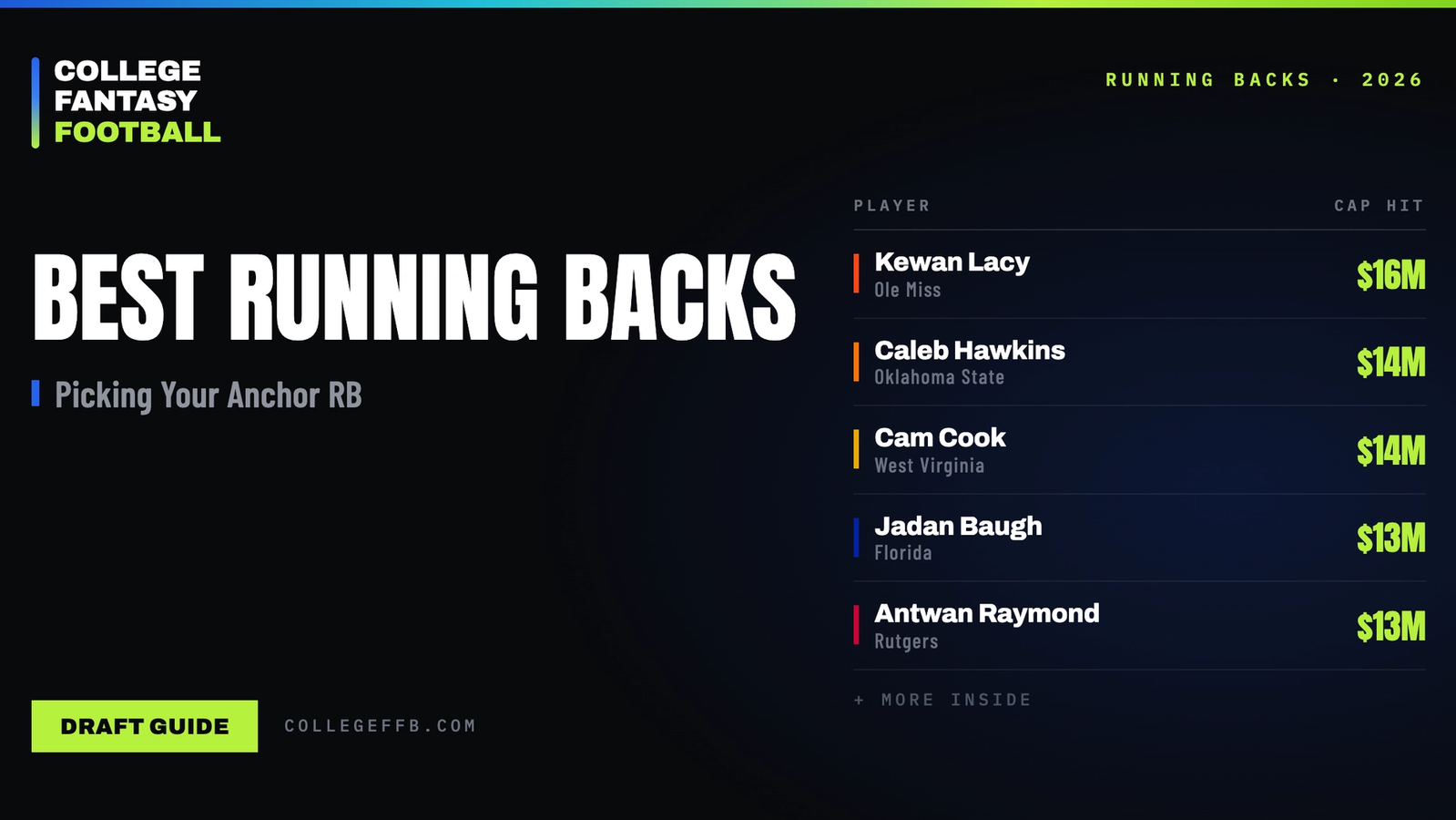
Best Running Backs in College Fantasy Football 2026: Picking Your Anchor RB
Running backs are priced at a premium for a reason. They touch the ball 20-plus times a week, they get the goal-line work, and their production is the most predictable on the field. Nobody is guessing whether a lead back gets 18 carries. You guess every single week with receivers.
That predictability is what you're buying. It's also why the top of the running back board eats a third of your cap if you're not careful.
Anyone can roster anyone in this format. Price is the only thing standing between you and the player you want. So the question isn't which back is best, it's which back you're building your roster around, and whether you can afford a second one.
Get that call right and you have a floor that holds through November. Get it wrong and you spend the back half of the season streaming receivers trying to climb back.
Here are the fourteen backs at the top of the board, what each one actually gives you, and how to fit them together.
Tier 1: The bell cows
These are the backs with the clearest path to 240-plus carries. You are paying for volume certainty.
Kewan Lacy, Ole Miss, $16.0M
Lacy led all of FBS in carries last season with 306. He turned that into 1,564 yards and 24 rushing touchdowns, the most in the SEC, and became the first Doak Walker Award finalist in Ole Miss history. He also caught 29 passes, which is more than most people realize. Trinidad Chambliss won his eligibility case and returns at quarterback, which matters more than it sounds. A real dual-threat behind center keeps safeties honest and keeps Lacy out of eight-man boxes.
The honest counterpoint is that Ole Miss spent the offseason talking about taking carries off him and brought in transfer depth to do it. Three hundred and six carries is not a repeatable number for anyone. But even a 20 percent haircut leaves him around 245 touches with a proven 24-touchdown ceiling attached.
He is 12.5 percent owned, which is the highest number on this list. You are paying full retail for the safest floor in the game.
Jadan Baugh, Florida, $13.0M
ESPN polled more than twenty NFL front office staffers and they came back with Baugh as the second-best running back in college football. PFF has him 37th overall on their preseason top 50.
He produced 1,170 yards on 220 carries plus 33 catches for 210 yards and two receiving scores, all on a team that averaged 21.6 points per game, and he closed the season with 266 yards against Florida State. He is 6-1, 228, and has fumbled once in 354 career carries. Texas tried to buy him out of the portal and Florida paid to keep him.
Buster Faulkner recruited Baugh out of high school and just brought his run-first system to Gainesville, which is the single most important development for his outlook.
Eight rushing touchdowns on 1,170 yards is the one number holding him back, and it is a function of a broken offense last year rather than the player. If Florida is above average this fall, and my bet is that they will be with this new coaching staff, expect that number to move up significantly and for Baugh to become the best value on the board.
Cam Cook, West Virginia, $14.0M
Cook led the entire country in rushing last year: 295 carries, 1,659 yards, 16 touchdowns, plus 30 catches for 286 yards. That is 1,945 yards from scrimmage, and he forced 100 missed tackles doing it. He was Conference USA Player of the Year and Newcomer of the Year.
Rich Rodriguez went and got him because West Virginia didn't have a single back clear 400 yards in 2025, then rebuilt the offensive line specifically to fix it. Behind Cook on the depth chart: a JUCO transfer and a couple of true freshmen. There is no committee coming.
Walter Camp already put him on the preseason All-America second team. Two things get missed in the level-of-competition argument: Cook spent his first two college seasons at TCU, so Big 12 defenses are not new to him, and his Jacksonville State offensive line coach Rick Trickett followed him to Morgantown. He sits at 1.3 percent ownership anyway.
Tier 2: The high-efficiency bets
Elite per-touch producers with a question mark attached to each.
Caleb Hawkins, Oklahoma State, $14.0M
As a true freshman at North Texas, Hawkins led FBS with 25 rushing touchdowns, ran for 1,434 yards, and added 32 catches for 370 yards and four more scores. Twenty-nine total touchdowns led the country, as did his 13.4 points per game. PFF gave him a 94.1 rushing grade. That was the best mark of any back in the country and the best by a true freshman since PFF started charting in 2014.
Then he followed his head coach and his quarterback from Denton to Stillwater. Same offense, same play caller, same guy handing him the ball. That continuity is the part getting underrated while everyone looks at Oklahoma State's one-win season and the five transfer backs they added.
Twenty-nine total touchdowns is the highest scoring output of anyone in this pool, and the four receiving scores mean it is not purely a goal-line number. He is 3.8 percent owned.
The question: are all the North Texas transfers enough to turn around a struggling Oklahoma State program? A stud back on a contending Big 12 team is a lot different than a talented runner on a program that can't clear four wins. You have to take your bet on whether the talent infusion from North Texas is enough to make this a good fantasy situation.
Isaac Brown, Louisville, $13.0M
Brown led FBS in yards per carry at 8.8. Even in an injury-shortened season he produced 884 yards on 101 carries with seven scores across nine games, including a 205-yard afternoon on 14 carries against Boston College, and he came back healthy for the bowl to hang 102 and two touchdowns on Toledo. As a freshman in 2024 he was ACC Rookie of the Year with 1,173 yards, 11 touchdowns, and 30 receptions.
That is 2,057 yards and 18 touchdowns across two seasons, and he is only a junior. He was the highest-rated back available in the portal and Louisville held off the field to keep him.
The question is health. There have already been reports out of camp that Brown has been banged up, and history tells us that is his biggest hurdle in 2026. Worth noting for PPR purposes: his receiving work fell off a cliff last year, from 30 catches as a freshman to 13, and what he did catch was dump-offs.
Highest ceiling per touch on the board. Lowest confidence in how many touches.
Justice Haynes, Georgia Tech, $11.5M
The cheapest name-brand back available. Haynes averaged 7.1 yards per carry at Michigan with 857 yards and 10 touchdowns in seven games, opening the season with five straight 100-yard performances before a foot injury ended his year.
Georgia Tech paid to bring him home because they are breaking in a quarterback with 25 career pass attempts and have said publicly that the plan is to lean on the ground game. He is healthy and he is the listed starter.
The question: what does that backfield split look like? Malachi Hosley is a legitimate 1B who went for 697 yards at better than seven a carry and will likely be more involved in the receiving game where Haynes isn’t going to give you much: 13 catches in seven games and 50 total yards last year. Regardless, at $11.5M for a back who could lead the ACC in rushing, that is backup money for starter production.
Tier 3: The volume-plus-receiving profile
These backs win you weeks through catches, which is the most overlooked source of points in this format. A reception is a point before the ball moves an inch.
LJ Martin, BYU, $13.5M
Big 12 Offensive Player of the Year and the preseason pick to repeat. Martin led the conference in both carries (236) and rushing yards (1,305) with 12 touchdowns at 5.5 a clip, and added 36 receptions for 255 yards, the second-most catches of any back in this pool. BYU enters the year in the preseason top 15 running a run-first offense, and Martin needs 1,361 yards to pass Jamaal Williams as the school's all-time leading rusher, with Harvey Unga's second-place mark falling at 915. Unga is now his position coach. That is an institution with every reason to feed him.
He is flagged questionable after December shoulder surgery, which cost him the bowl game, and he has said he is ready.
The thing to price in is Bear Bachmeier. BYU's quarterback takes 15 to 20 carries a game and vultures goal-line work, which is why Martin's touchdown totals have never matched his yardage.
Darius Taylor, Minnesota, $12.0M
The most consistent target of any back here. Ninety-nine career catches and 687 receiving yards across three seasons, including a 54-reception, 350-yard year in 2024 and another 34 catches in just ten games last fall. That per-game rate is the highest in this group, and it means his bad weeks are still functional weeks.
The rushing profile holds up too: 2,455 career yards at 5.1 a carry. In all four games last season where he got 19 or more carries, he cleared 100 yards.
Health is the entire question. He has never made it through a full season, going six games as a freshman and ten last year. He reworked his offseason around fixing it.
Buy him as a second back and let the receptions carry your floor. Do not build a roster that needs thirteen games from him.
Nate Sheppard, Duke, $11.5M
Second-team All-ACC as a true freshman on a team that won the ACC outright, plus Freshman All-America from The Athletic. Across 14 games Sheppard ran 200 times for 1,132 yards and 11 touchdowns at 5.7 a carry, and caught 37 passes for 286 yards and another score. That is the most receptions of any back in this pool.
PFF ranks him the No. 7 returning running back in the country. Duke averaged 33.9 points per game and he was the every-down back inside that offense as an 18-year-old, handling pass protection well enough to stay on the field on third down. He closed the year with 170 yards in the Sun Bowl.
Darian Mensah left for Miami, so Duke has a new quarterback and the offense has to prove itself again. The workload and the target share are not in question.
Tier 4: Situations worth monitoring
Cheaper access to premium jobs, with more to figure out.
Mark Fletcher Jr., Miami, $13.0M
Fletcher put up an ACC-high 1,192 yards on 216 carries with 12 rushing touchdowns, and the biggest games came in the biggest spots: 172 yards against Texas A&M in the first round of the playoff and 112 with two scores in the national championship game. His 507 postseason rushing yards are the most in CFP history. He is 6-2, 228, on a team that expects to be back there, and he turned down the draft to run it back.
Miami's backfield is the deepest in the country and they know it. Jordan Lyle, ChaMar Brown, and Girard Pringle are all real players, and Miami ran a committee right up until the playoff started. The receiving line is 17 catches for 140 yards with four drops on 22 targets, and his pass protection graded poorly, which is how a 225-pound back ends up off the field on third down.
Fletcher looked phenomenal in the College Football Playoffs last year, the issue is you don't know if he'll get that same kind of volume in the 2026 regular season.
Antwan Raymond, Rutgers, $13.0M
The college fantasy community figured this one out early and they were right to. Raymond put up 1,241 yards and 15 total touchdowns, made second-team All-Big Ten, went to the Doak Walker semifinals, landed on the Maxwell watch list, and won the Cornish Trophy as the best Canadian player in the sport.
The Maryland game tells you everything. Forty-one carries, 240 yards, tying a Rutgers single-game record for attempts. Schiano gave him the ball until the clock ran out because that is the entire offensive plan.
There is nobody behind him and this is the same Rutgers that produced Isiah Pacheco and Kyle Monangai in back-to-back cycles and Raymond is further along than either was at this stage.
The issue here, and it’s worth flagging, is going to be the overall offense. Rutgers does not have the easiest Big Ten schedule, so while Raymond might have some massive spike weeks, he might also have a few weeks where he’s written out of the gamescript before the end of the first quarter. Buyer beware.
That said, the beauty of a salary cap model is you get three free transfers a week. Smart managers can really get their money’s worth here.
DeSean Bishop, Tennessee, $12.5M
Sixteen rushing touchdowns on 182 carries. That is the best scoring rate on this entire list, and touchdowns are what actually decide weeks. Add 1,076 yards at 5.9 a carry, 649 of them after contact, and second-team All-SEC honors.
ESPN has him as Tennessee's best award candidate and four offensive line starters return. Heupel is breaking in a freshman quarterback, which means loaded boxes, but it also means Tennessee leans on the run to protect him. The receiving work is thin at 15 catches for 135 yards, so the scores have to carry it.
Cheapest access to double-digit touchdowns in the top tier.
Aneyas Williams, Notre Dame, $12.0M
Jeremiyah Love and Jadarian Price both went in the first round and both are gone. Marcus Freeman has said publicly that Williams is the featured back. He has averaged 9.3 yards per carry last year, albeit a limited sample.
He showed some real explosiveness last year, but the risk is the sample size we have on him. He was buried behind the two best RBs in the country last year, so this is a situation where we’re trusting our eyes, and Marcus Freeman’s ability to recruit phenomenal running backs.
Highest variance play on the board, attached to the best job.
Ahmad Hardy, Missouri, $11.0M
When healthy, Hardy is the best running back in the country. He ran for 1,649 yards and 16 touchdowns last season, led the nation in yards after contact with 1,186, forced 97 missed tackles, and posted the best PFF elusive rating in the country at 179.0. He entered the offseason as a Doak Walker favorite and a projected first-round pick.
The caveat is significant and you need to plan around it. Hardy was shot in the leg in May and had surgery. He was medically cleared at SEC Media Days in late July, but Eli Drinkwitz put the return-to-play progression at five to eight weeks and said plainly that there isn't much medical literature to go on. Five weeks puts him near the September 3 opener. Eight weeks puts him closer to the September 27 trip to Mississippi State. Drinkwitz also acknowledged that even at the end of that window, nobody knows whether he is the same back.
Jamal Roberts handles the load until Hardy returns and keeps a role after.
This is probably a wait and see scenario, but once he’s back with a full workload, I have no doubt his ownership will sky rocket.
Building around your pick
Every back on this list is one of the best in the sport. That is the whole reason they cost what they cost. The decision isn't who is good, it's who returns the most for the price, who you trust enough to captain in September, and who moves you the furthest up the leaderboard while everyone else is still figuring out their roster.
You get transfers every week. But this pick is what your team looks like for the first few weeks of the season, and those weeks count the same as the rest of them.
-------------------------------------------
For additional insights, make sure to check out some of our other analysis pieces ahead of the 2026 CFB Fantasy season:
Sign up today and start creating your team!
About the Author
Sam Horbal
Sam Horbal is the founder and developer of CollegeFFB, a free college fantasy football game and home of the CFB Hub. A lifelong college football fan, Sam built CollegeFFB to make following the sport more interactive, from fantasy play to stats and rankings.