College Fantasy Football Leagues | CollegeFFB
Sam Horbal
Sam Horbal is the founder and developer of CollegeFFB, a free college fantasy football game and home of the CFB Hub. A lifelong college football fan, Sam built CollegeFFB to make following the sport more interactive, from fantasy play to stats and rankings.
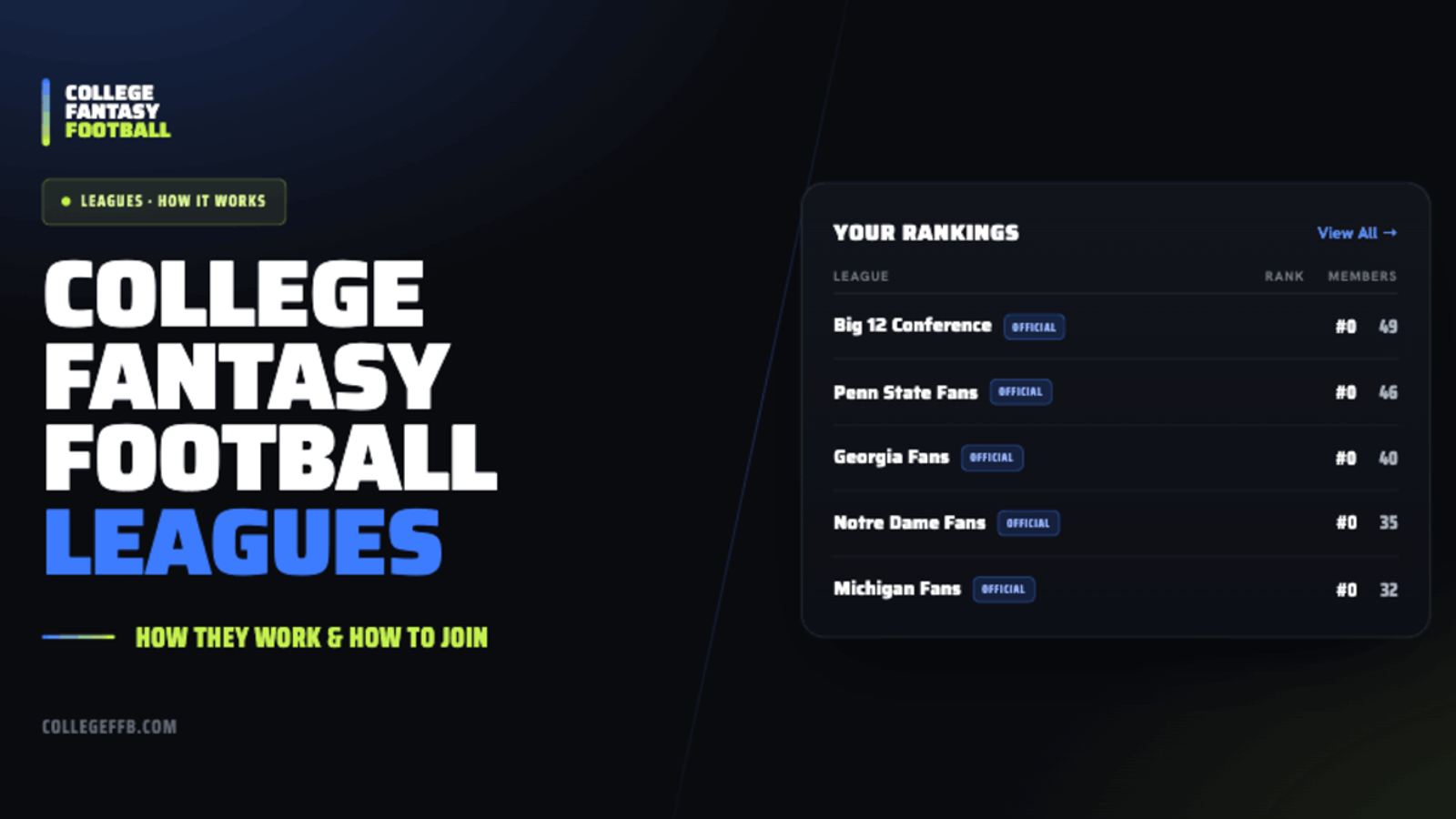
How Leagues Work in CollegeFFB
This question comes up more than any other, so here it is in one place.
CollegeFFB isn't a traditional draft format, so the league format had to change too. We wrote a whole article on why the format had to change for college, so we won't rehash that here.
The short version: we're a salary cap game. Everyone starts the year with a $100 million budget. Everyone has access to the same player pool. Everyone gets two captain picks each week. So it comes down to who builds and maintains the smartest team week over week, not who drew the easier matchup against the guy who can only name five players outside his alma mater.
The format is a leaderboard, not a matchup
This is the part people actually get wrong.
There is no weekly opponent. Nobody to beat. Nobody to trash talk in a chat that eight of eleven managers have muted. Every roster puts up a score each week and you get ranked by points. Set a good lineup, you climb. Whiff, you drop.
That matters more than it sounds. Head to head fantasy has a well-documented failure mode: you build the best roster in the league, score the second-most points all year, and go 6-7 because the schedule decided you should play the hot team every week. Everyone has lived this. Everyone has explained it to a friend who did not care.
The leaderboard doesn't do that. Points are points. You're playing the field, and the field doesn't get lucky at you. Nobody's backup tight end hangs 34 on you in Week 9 and changes your season. If you finish behind someone, it's because they scored more. Simple, and occasionally brutal.
It also keeps you alive. In a head to head league, a 1-5 start means you're done and you know it, and by Week 8 you've stopped setting your lineup. On a leaderboard you're always some number of points from a better number. The season stays live longer.
You're in three leagues before you do anything
When you sign up, you pick your favorite team. That one choice drops you into three leaderboards automatically.
Global. Everyone on the platform. This is where you find out whether you actually know college football or whether you just watch a lot of it.
Your conference. Everyone who picked a team in your conference. Realignment being what it is, your conference may contain schools separated by two time zones and a shared inability to explain why. Beat them anyway.
Your team. Everyone who picked your school. This is the fun one. This is where you get to find out you are the 47th-best fantasy manager among people who own the same hoodie as you. It is oddly personal. It should be.
No setup. No invites. No commissioner. You pick a team and you're playing three competitions at once.
And then there are mini leagues
The three defaults are the baseline. Mini leagues are for your people.
Spin one up, share the link, drop it in the group chat. Same rosters, same scoring, smaller field. This is where the actual trash talk lives, because the global leaderboard is thousands of strangers and your group chat is six guys who will absolutely bring this up at a wedding.
Be in as many as you want. Your roster is your roster and it competes everywhere at once. Build one team, run it in every leaderboard you're in.
Why it's built this way
College football has around 130 teams. Traditional fantasy formats were designed for a 32-team league where everyone knows every starter. Try snake drafting a sport where half the relevant players transferred in April and the other half you've never seen play a snap.
A shared pool fixes that. You don't need to know all 130 rosters, you need to know where the price is wrong. And a leaderboard means you don't need to find eleven friends who'll commit to a four-month schedule. You need to show up and set a lineup.
That's it. Pick a team, get a budget, build a roster, climb.
See you on the board.
About the Author
Sam Horbal
Sam Horbal is the founder and developer of CollegeFFB, a free college fantasy football game and home of the CFB Hub. A lifelong college football fan, Sam built CollegeFFB to make following the sport more interactive, from fantasy play to stats and rankings.