Best Value QBs for College Fantasy Football in 2026
Sam Horbal
Sam Horbal is the founder and developer of CollegeFFB, a free college fantasy football game and home of the CFB Hub. A lifelong college football fan, Sam built CollegeFFB to make following the sport more interactive, from fantasy play to stats and rankings.
Every fantasy team starts with a quarterback and a budget. In CollegeFFB you get $100 million to build a full roster, and the quarterback you take sets the tone for everything after him. Spend big at the position and you had better be right. Spend smart and you keep the cash that wins you the other spots.
Value is not the same as production. The best value quarterback is not always the one who throws for the most yards. It is the one who returns the most points relative to what he costs, and just as important, the one whose price leaves you enough room to fill out the rest of your team. The premium arms in the game run $13M and $14M. Every quarterback on this list comes in under $10M, so the whole board is already priced at a discount. The question is not who is cheap. It is which discount returns the most, and which one still leaves you a roster.
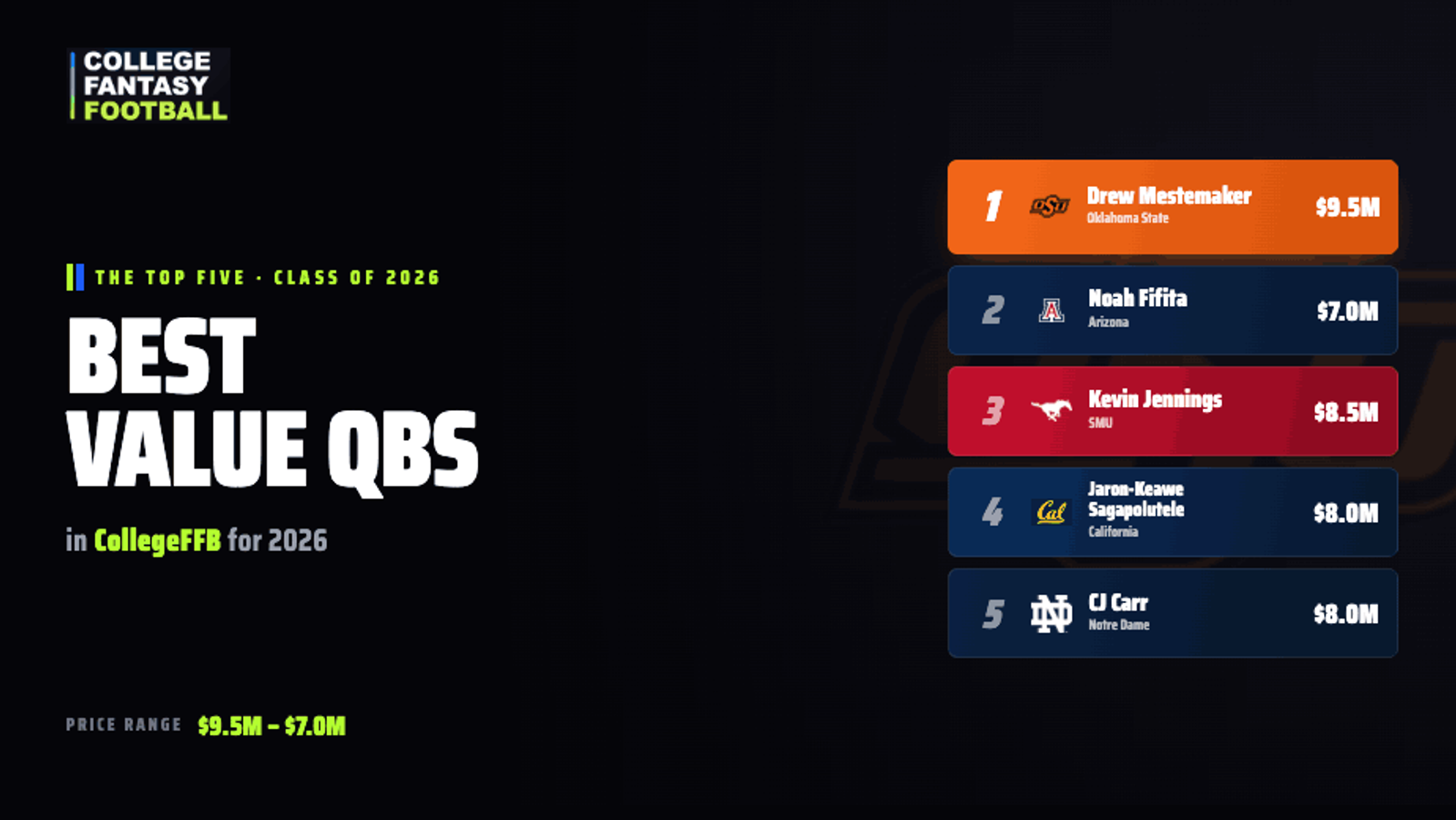
Here are the best quarterback values on the board for 2026, ranked, followed by four honorable mentions who deserve a look when the roster math gets tight. Prices are current CollegeFFB values. Stat lines are full 2025 seasons including bowl games.
1. Drew Mestemaker, Oklahoma State — $9.5M
2025 (North Texas): 4,379 passing yards, 34 TD, 9 INT, 68.9% completion, 89 rushing yards, 5 rushing TD.
Mestemaker led all of FBS in passing yards last season, won the Burlsworth Trophy, and was the AAC Offensive Player of the Year. That is the highest passing ceiling on this board, full stop. His raw production belongs in the same room as Arch Manning and Trinidad Chambliss at $14M and Devon Dampier at $13M.
So why is he $9.5M and not $13M? He did all of it as a G5 quarterback and never faced a single Power opponent. The market is discounting the opponents he faced, not the arm. He follows coach Eric Morris to Oklahoma State to run the same Air Raid, and ESPN still ranked him the No. 5 quarterback prospect in the country. The talent is real.
The catch, and the reason he is the boom-or-bust pick, is the schedule. Oklahoma State went 1-11 last year, and the slate is a Big 12 grind: Oregon in Week 2, then Texas Tech, at Arizona State, at Kansas State, and at Iowa State. It’s a manageable schedule, but it's certainly much more daunting than what he faced at North Texas.
Value verdict: The bet is simple. If a G5 passing champ's numbers travel to the Big 12, you got a $14M ceiling for $9.5M and it is the best value in the game. If they don't, you paid up for a guy learning what a Power defense looks like on a team that has not won a conference game in two years. Highest ceiling on the board, lowest floor in this tier, priced right in the middle. Swing for it if you can afford the miss.
2. Noah Fifita, Arizona — $7.0M
2025: 3,228 passing yards, 29 TD, 6 INT, ~64% completion, 222 rushing yards, 3 rushing TD.
Fifita set the Arizona single-season record with 29 touchdown passes, threw just six picks on 428 attempts, and became the first Wildcat in 50 years to earn first-team all-conference. He is a fourth-year starter back for a final run with offensive coordinator Seth Doege, the coach who unlocked this version of him.
Nobody points to a flaw here because there is not an obvious one. The discount is the absence of a story. He is not a freshman with a rocket arm or a transfer with buzz, he is a steady, accurate, 29-touchdown veteran, and steady does not get you priced up. His actual passing production stacks up with the $10.5M names like Marcel Reed, Conner Weigman, and John Mateer, but his rushing floor is much, much lower. But, hey, that’s why he costs $7.0M.
Value verdict: This is the floor play, and the floor is high. You get a proven 29-touchdown starter for $3.5M less than the $10.5M vets who did roughly what he did last year. Spend the difference on a running back. If you want production you can count on and money left to build a full team, Fifita is the smartest dollar on the board.
3. Kevin Jennings, SMU — $8.5M
2025: 3,641 passing yards, 26 TD, 13 INT, 66% completion, 4 rushing TD.
Jennings finished third in the ACC and seventh in FBS in passing yards, was a team captain, and started all 13 games, adding four rushing scores on the way to a 9-4 season and a Holiday Bowl win over Arizona. He is a senior with a strong arm and jump-cut escapability, back for another year in Rhett Lashlee's offense, which averaged better than 32 points a game in ACC play last season.
People will point to the 13 interceptions and the dip from a 26-11 ratio in 2024. It matters less than it looks. The discount comes from the drop in rushing yards from 2024 to 2025. He went from 354 to 54 rushing yards, but our best guess is that it has more to do with being banged up down the stretch last year.
He gets a bit closer to those 2024 rushing numbers, and his value feels a bit closer to the John Mateer to Sam Leavitt range at $10.5M each.
Value verdict: Production and schedule. That is how you find value in College Fantasy Football. Jennings has a proven track record and his second hardest game this year is Louisville? Virginia Tech? I'll take those odds.
4. Jaron-Keawe Sagapolutele, California — $8.0M
2025 (true freshman): 3,454 passing yards, 18 TD, 9 INT, ~64% completion, 4 rushing TD.
As a true freshman, Sagapolutele threw for more yards than any Cal quarterback not named Jared Goff, started all 13 games, led the ACC in completions per game, and closed the year without an interception over his final 178 attempts. On3 named him the true freshman All-America quarterback. The arm is one of the best in the country.
The discount is the freshman tax. He is not a runner (sacks pushed his net rushing negative, so do not bank on points on the ground), and the film on him is still thin. But stack the arm and the workload against Darian Mensah, the priced-up ACC quarterback now at Miami, who costs $11M. Sagapolutele carried one of the biggest passing loads in the league as an 18-year-old, he is three million dollars cheaper than Mensah.
The schedule helps too. Cal misses Miami, Duke, Florida State, Louisville, and North Carolina off the ACC draw, gets an FCS body in Wagner, and no one on the slate makes me feel like I’ll need to transfer JKS out.
Value verdict: You are paying $8.0M for the highest ceiling in the mid-tier. The volume is already there, the trajectory says the touchdowns climb in year two, and the schedule gives him room to do it. The $3M gap between someone like JKS and Mesah is largely due to the difference in surrounding talent and O-line, but another step forward by the Sophomore might make that concern feel foolish by November.
5. CJ Carr, Notre Dame — $8.0M
2025 (redshirt freshman): 2,741 passing yards, 24 TD, 6 INT, 66.7% completion, 33 rushing yards, 3 rushing TD.
Carr was the most efficient young quarterback in the country. His 9.4 yards per attempt ranked second nationally, his 168.06 passer rating set a Notre Dame record, and his QBR ranked eighth in the nation. He was a Manning Award finalist and is a real 2026 Heisman contender. On talent alone he belongs in the $11M conversation with Darian Mensah and Demond Williams.
So why $8.0M? Volume. His 2,741 passing yards are the lowest of anyone in this tier, because Notre Dame handed the ball to one of the best backfields in the country and Carr did not have to throw it 40 times a game. That backfield, Jeremiyah Love and Jadarian Price included, is gone. The discount is the bet on whether the volume follows.
Two things say it will. The offense loses its run-game crutch, and the schedule could not be softer. USC and Florida State both came off the slate, the first six opponents all won four games or fewer last year, and the only real tests are at BYU, Miami, and SMU.
Value verdict: You are paying $8.0M for a top-ten efficiency quarterback with Heisman buzz and a schedule built for gaudy numbers. If the volume climbs even halfway to his talent, this is an $11M arm you got for eight. The only real question is whether Notre Dame lets him throw. Everything else says buy.
6. CJ Bailey, NC State — $8.0M
2025 (sophomore): 3,105 passing yards, 25 TD, 9 INT, ~69% completion, 215 rushing yards, 6 rushing TD.
The most complete stat line in the tier. Bailey threw for 25 touchdowns and ran for 6 more, cleared 3,100 yards, and posted a top-15 national QBR. He is 6-foot-6 with a live arm, 11 of his 25 touchdown throws traveled 20-plus yards downfield, and he barely gets sacked. He is back for his junior year.
And the schedule sets up for more. NC State misses Miami, Clemson, Georgia Tech, Pitt, Boston College, and Virginia Tech, opens against an FCS team in Richmond, and its own beat writers are openly asking whether the toughest game on the slate is Louisville, Vanderbilt, or Cal.
Value verdict: Passing and rushing touchdowns from the same slot is how you win weeks, and you are getting both for $8.0M against a soft draw. If the new receivers hold up, Bailey outscores the two names above him at the same price. This is the production-per-dollar pick.
Honorable Mentions
These are the names that make the budget math interesting. None of them will be the highest scorer at the position, but every one of them frees up cash you can spend somewhere else, and a couple of them do things at the quarterback slot that are hard to buy anywhere.
Rocco Becht, Penn State — $6.5M. The cheapest quarterback worth rostering. Becht regressed in an injury-hit 2025 at Iowa State (2,584 yards, 16 TD, 9 INT) before following coach Matt Campbell to Penn State, but he carries 26 career wins as a starter, the most of any returning quarterback in the country. He had labrum surgery on his non-throwing shoulder in the offseason with a spring return timeline. If he is healthy and the Penn State offense clicks, $6.5M for a proven Big Ten starter is the definition of punting the position and winning elsewhere. The health is the risk.
Will Hammond, Texas Tech — $7.0M. A tear ligament and a huge opportunity. Hammond played backup behind Behren Morton in 2025 (680 yards, 7 TD, 5 rushing TD) before a torn ACL ended his season. He is now the projected Week 1 starter for a Big 12 contender, if he is cleared. Cheap price, dual-threat profile, real upside on a good team. You are betting on the knee and the small sample. If it hits, this is one of the best values on the whole board. His spot was originally going to be occupied by a $12.5M premium QB… but, you know, things happen.
Alonza Barnett III, UCF — $8.0M. The reigning Sun Belt Player of the Year at James Madison: 2,806 passing yards, 23 passing TD, 8 INT, plus 589 rushing yards and 15 rushing scores, for 38 total touchdowns and a College Football Playoff appearance. He transfers up to UCF and Scott Frost's offense and was named the starter. The dual-threat production is real. The questions are the jump to Big 12 defenses and some 2026 injury noise out of camp worth tracking before you commit $8.0M.
Colton Joseph, Wisconsin — $7.5M. The rushing cheat code. Joseph won Sun Belt Offensive Player of the Year at Old Dominion by throwing for 2,624 yards and 21 touchdowns while running for 1,007 yards and 13 more scores, finishing eighth in the country in total offense. A quarterback who clears 1,000 yards on the ground is worth a hard look in any format that rewards rushing. He transfers to Wisconsin as Luke Fickell's projected starter. The Big Ten step up is the whole question, but at $7.5M you are buying a genuine 34-touchdown dual threat.
Best Bench Stashes
Two names for the back of your roster. You are not starting either one in Week 1. You stash them because they are the cheapest quarterbacks worth owning, they already have starting reps, and both landed somewhere with a real path to points. If one pops, you got a starter for $5.5M. If neither does, you are out almost nothing.
Aidan Chiles, Northwestern — $5.5M. A former four-star with two-plus years of Big Ten starting experience, now the favorite to open 2026 under new offensive coordinator Chip Kelly. His 2025 at Michigan State was a mess: benched in November, then a foot injury that ended his year at 1,392 yards, 10 TD and 3 INT over nine games. But he is a real dual threat with 12 career rushing scores, and a Chip Kelly offense is a soft landing spot. Cheap insurance with a starter's ceiling if the reset takes.
Cutter Boley, Arizona State — $5.5M. An SEC All-Freshman pick who started Kentucky's final 10 games as a redshirt freshman: 2,160 yards, 15 TD, 12 INT, and a five-touchdown game against Tennessee. He is 6-foot-5 with a live arm, three years of eligibility, and the likely starter for Kenny Dillingham after Sam Leavitt left. Dillingham reloaded the receiver room around him. The 12 interceptions are why he is a stash and not a starter, but the traits and the situation are worth $5.5M on your bench.
How to use this
Do not just take the highest name you can afford. Look at what the price does to the rest of your roster. Fifita at $7.0M and Bailey at $8.0M give you proven production while leaving real money for skill positions. Becht and Hammond are the plays when you want to spend $6.5M to $7.0M at quarterback and load up everywhere else. Joseph is the one who scores in a way you cannot easily replace, because rushing yards from the quarterback slot are rare. And Mestemaker is the swing: the most expensive name here is still well short of a premium arm, so you are paying up for a $14M ceiling and betting the G5 tape travels. Hit and you win your league. Miss and you might wish you had ponied up for Arch Manning.
The budget is the whole game. You can go premium (we’ll have an article on that soon) but that means giving up points elsewhere. Choose wisely and start building your team today.
About the Author
Sam Horbal
Sam Horbal is the founder and developer of CollegeFFB, a free college fantasy football game and home of the CFB Hub. A lifelong college football fan, Sam built CollegeFFB to make following the sport more interactive, from fantasy play to stats and rankings.